

What is COVA-X?
COVA-X is a fully synthetic dataset of approximately 11,000 AI-generated, English-language, multi-turn scam conversations modeled on fraud techniques used against older adults. It exists for one purpose: to help researchers build and evaluate systems that detect social-engineering fraud. Every conversation is machine-generated — no real victims, no real communications, and no personal data of any kind.
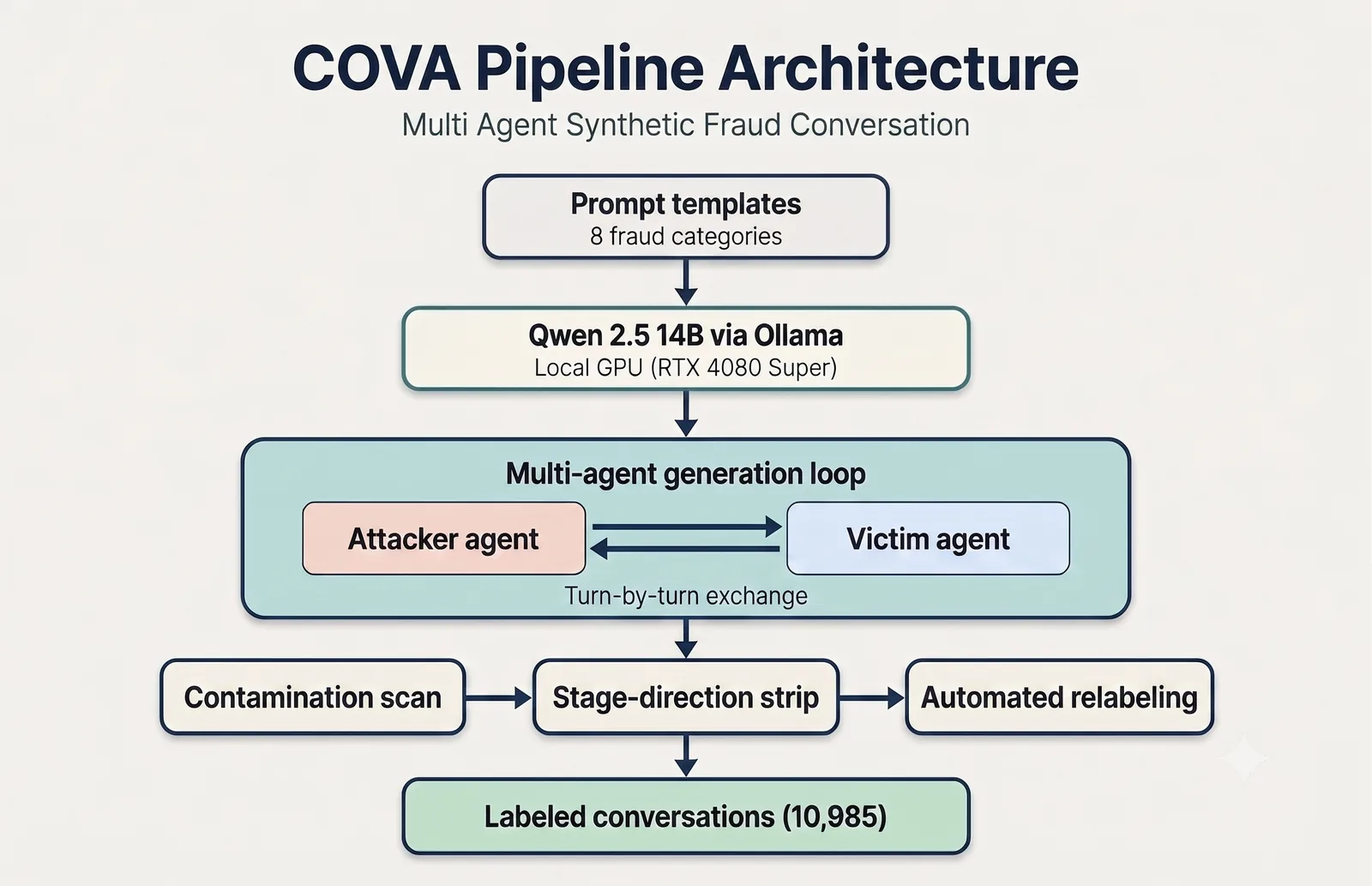
Generation runs entirely on local, offline research hardware using an open-weight language model (Qwen 2.5 14B via Ollama) — no cloud services and no third-party data exposure at any stage. The full methodology, generation pipeline, and quality-assurance process are documented in the peer-submitted papers linked above.
Each record carries structured metadata alongside the dialogue — scam type, outcome label, turn count, victim parameters, and data-quality flags:
Illustrative structure only — field names and format match the dataset; values shown are placeholders. Full schema documentation accompanies each data distribution.
Requesting access
The dataset is shared by request with researchers and organizations working on fraud detection and prevention. All conversations are in English — the dataset does not currently include other languages.
- Email requests@scamlingua.org (Attn: Carl Lochstampfor) with your name, institutional affiliation, and a brief description of your intended use — or use the pre-filled request template.
- Access is granted for non-commercial, defensive research use — detection, prevention, and evaluation (see Responsible use). Redistribution is not permitted.
- Any publication or product of research using the dataset must cite the reference below.
By submitting a request, you confirm that you have read and agree to these terms. Approved requests receive an access code invitation by reply email — please confirm receipt within 72 hours so it doesn't get lost in spam.
Tip for faster review: requests sent from an institutional email address (university or organization domain) are typically processed fastest. Students — CC'ing your supervising professor or thesis advisor helps us confirm research alignment quickly. Requests from personal email accounts are welcome, but may involve a brief follow-up to confirm affiliation.
All requests are reviewed for research alignment.
Please allow at least 3 - 7 calendar days for a response.
https://arxiv.org/abs/2606.06879